
Memory Explorer
Explore and search client-side decrypted memory records locally.
| Deployment Model | Availability |
|---|---|
| Platform | ✓ Available |
| Self-Hosted | ✓ Available |
Honesty Ledger (Provenance Layer): The memory explorer processes records at the Client-derived (Layer B) layer.
ZK Trust Boundary:
- What the server sees: Nothing (no search requests, vector indexing, or decrypted responses ever touch the server).
- What stays on device: The search query, memory filters, sorted results, and cleartext text strings.
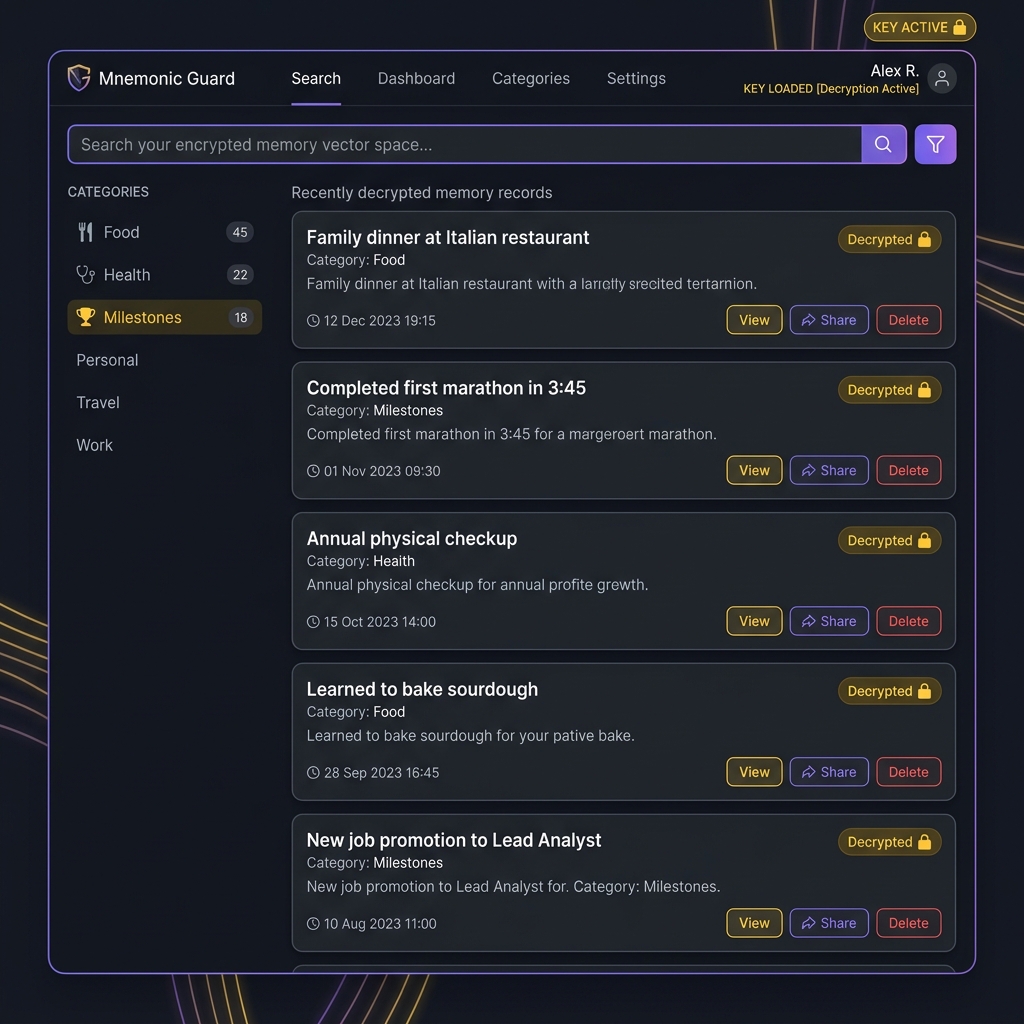
Client-Side Memory Explorer
The Memory Explorer allows developers and agents to explore, search, filter, and audit memory logs. Because the remote storage endpoints are encrypted, exploring records requires you to load your project key vault first.
Key Features
- Pre-requisite Key-Load: If the key is not loaded, the explorer displays a
LockedStategate, protecting memories from unauthorized physical or browser access. - In-Browser Search Index: When you search (by typing in the search bar or clicking Category Tabs like Food, Health, or Milestones), the search executes 100% client-side. The query text is never transmitted over HTTP. The browser filters the decrypted cache in memory.
- Sequence Numbers & Timestamps: Memory envelopes carry sequence numbers and creation timestamps that represent the order of replication syncs.
- Visual Local Deletion (Tombstones): Deleting a record from the explorer visually removes it locally. Since the server cannot decrypt content, deletion tombstones are processed in-browser.
Cryptographic Lineage Verification Drawer
Clicking on a memory row expands the Zero-Knowledge Verification Drawer. This panel reveals the raw encrypted envelope payload stored on the server:
- Ciphertext (Base64): The raw AES-256-GCM ciphertext envelope.
- IV (Base64): The random Initialization Vector used during encryption.
- VSR SHA256 Hash: The Verified Semantic Recall hash.
The browser verifies the AES-GCM authentication tag and proves the integrity of the record before rendering it.
Offline Reference Analogs: This documentation was written with visual and rhythm reference to platform/features/platform-overview.html.