
Verified by the sovseal team
Entities
Categorize and track derived entities from decrypted memories.
| Deployment Model | Availability |
|---|---|
| Platform | ✓ Available |
| Self-Hosted | ✓ Available |
Honesty Ledger (Provenance Layer): Entities are extracted and filtered strictly at the Client-derived (Layer B) layer.
ZK Trust Boundary:
- What the server sees: Nothing. The server does not perform entity extraction and has no record of entity names.
- What stays on device: Categorized entity rosters, update logs, and deletion tombstones.
Client-Derived Entities
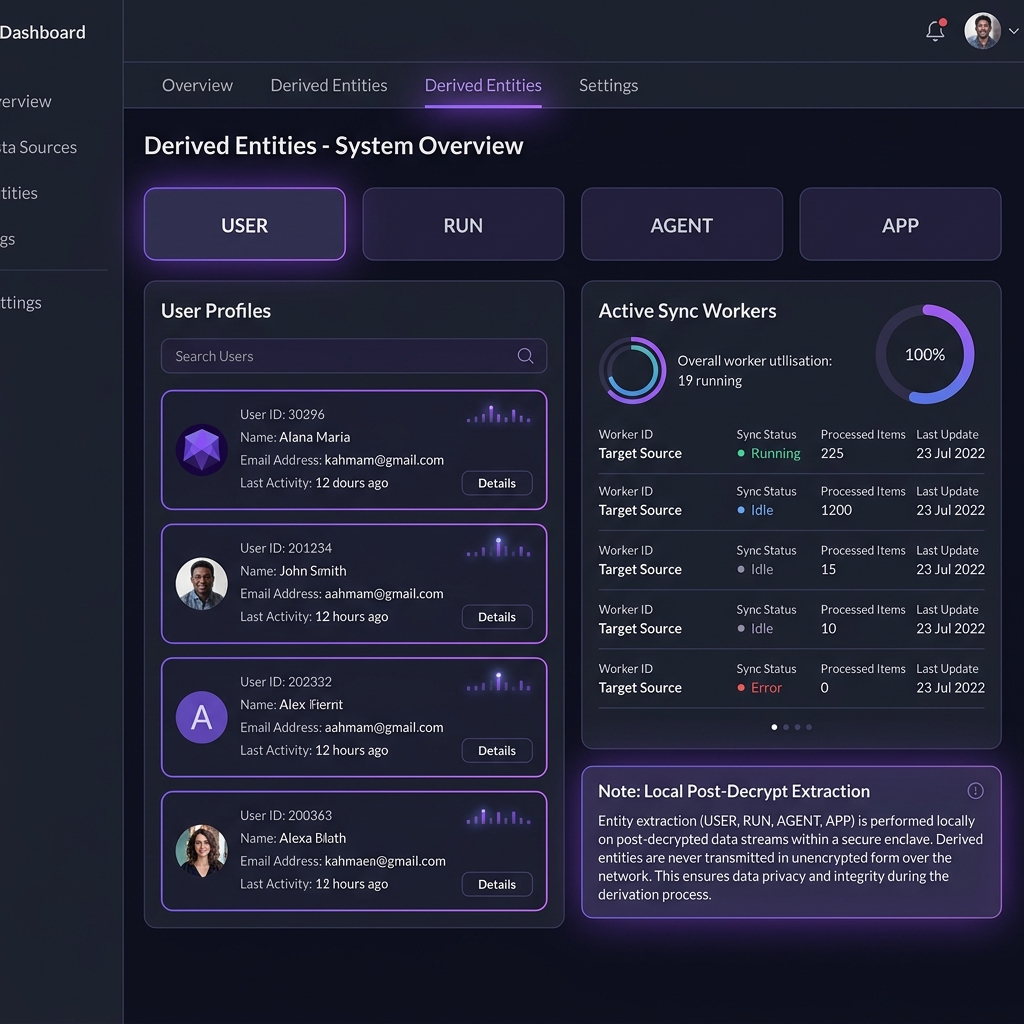
Entities represent distinct concepts, users, runs, or agent tasks referenced within your memory history. To protect privacy, entities are not compiled or extracted on the server.
Category Classification
When you load your project key and unlock the screen, the browser traverses your decrypted memory records and extracts entity keywords, placing them into four categories:
- USER: Human profiles, operators, or administrators (e.g.
chrome-extension-user,system-administrator). - RUN: Active execution contexts or sync jobs (e.g.
sync-worker-01). - AGENT: Specific assistant profiles or MCP instances (e.g.
memory-mcp-agent). - APP: Integrated client systems, editors, or databases.
Zero-Knowledge Deletion
Deleting an entity from this list is a local-only operation:
- No Network Activity: Deleting an entity creates a client-side blacklist in the browser.
- ZK Constraint: Because the server holds only ciphertext envelopes, it is cryptographically impossible to issue a server-side "delete entity" instruction without decrypting all records on the server.
- SDK Safety: Deleted entities are filtered out in the browser memory during active sessions.
Offline Reference Analogs: This documentation was written with visual and rhythm reference to platform/features/platform-overview.html.